Company profile · NFLX
Netflix
Streaming entertainment
Exceptional Company Series · No. 3
Passes all five structural tests and clears our elevated bar on both the strength of the business today and the consistency of its earnings record. An assessment of business quality, not a buy signal — exceptional can also be expensive. Why → · About the series →
Listen instead
4:20 · 4.2 MB · narrated by a synthetic voice, not by the author
Read the transcript
This is The Conviction Play. Netflix, streaming entertainment. Number three in our Exceptional Company Series, the businesses our framework grades exceptional.
Netflix sells one thing: a monthly subscription to watch what it has made or licensed. The economics turn on a fact easy to miss, a programme costs the same to make whether ten people watch it or two hundred million, so every additional subscriber on an existing show is close to pure profit. That is why the business spent a decade looking expensive and then, once the audience was large enough to carry the content bill, began converting growth into profit at a rate very few businesses reach. Earnings have compounded at 44.6% a year over twelve years, and the current strength of the business reads higher on our checks than any other company we have assessed. That is what we mean by a structural compounder.
A subscription streaming service operating worldwide, which both licenses programmes and increasingly makes its own. Netflix stopped reporting subscriber numbers in 2025, saying revenue and operating margin better represent the business, so those are what we judge it on.
Why the economics are exceptional. Fixed cost, unlimited audience. A season of television costs what it costs. Whether it is watched by ten million households or a hundred million changes the revenue and barely touches the cost. Netflix spent a decade on the wrong side of that equation, funding a slate for an audience it did not yet have; it is now firmly on the right side of it.
Scale is the moat, and it compounds. The largest subscriber base funds the largest content budget, which is what retains the largest subscriber base. A rival must outspend Netflix while earning less from the spending, possible with a deep enough parent, but not indefinitely rational.
The advertising tier is margin, not just revenue. It monetises price-sensitive households that were never going to pay full subscription, on content already commissioned and already paid for.
The honest risk, and it has changed. Netflix has agreed to acquire Warner Bros. Discovery's streaming and studios businesses, HBO, HBO Max, the film and television studios, and has committed 42.2 billion dollars of bridge financing to do it. Its own filing states the transaction will materially increase outstanding indebtedness. Every figure on this page describes the business as it has been: debt-light, self-funding, compounding on its own cash. The company that emerges from this deal will be a different one, and the record above cannot speak for it. Rivals with deeper pockets were the risk before; execution and leverage are the risk now.
Three numbers to take away. Over 12 years, earnings per share compounded at 44.6% a year. 81% of the year-on-year comparisons were up. The worst fall in earnings was 20%.
The written profile of Netflix is on the site, and it goes further than this: the twelve-year earnings record as a chart, the figures behind every claim you have just heard, and the sources for all of them. It is free, with no email address and no paywall.
The Exceptional Company Series also covers Intuitive Surgical, Microsoft and IDEXX Laboratories. Everything we publish is at the conviction play dot com, and the recordings are collected there under Listen.
A note before we finish. This episode is narrated by a synthetic voice, not by the author. This is an assessment of business quality. It is not a valuation, not a price target, and not a recommendation to buy or sell anything. A company can be exceptional and still be expensive. The Conviction Play publishes general commentary for information only. It is not investment advice and it is not a personal recommendation. Capital is at risk, and the value of investments can fall as well as rise. This assessment reflects what was known on the date of recording, and nothing in it updates itself.
That was Netflix, number three in the Exceptional Company Series, from The Conviction Play. Thank you for listening.
The one-minute version
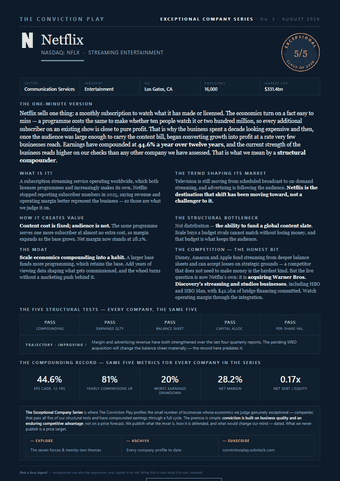
Netflix sells one thing: a monthly subscription to watch what it has made or licensed. The economics turn on a fact easy to miss — a programme costs the same to make whether ten people watch it or two hundred million, so every additional subscriber on an existing show is close to pure profit. That is why the business spent a decade looking expensive and then, once the audience was large enough to carry the content bill, began converting growth into profit at a rate very few businesses reach. Earnings have compounded at 44.6% a year over twelve years, and the current strength of the business reads higher on our checks than any other company we have assessed. That is what we mean by a structural compounder.
The five structural tests
Trajectory: improving ↑ — Margin and advertising revenue have both strengthened over the last four quarterly reports. The pending WBD acquisition will change the balance sheet materially — the record here predates it.
The compounding record
The same five measures for every company in the series, so any two can be read against each other.
Why the economics are exceptional
Fixed cost, unlimited audience. A season of television costs what it costs. Whether it is watched by ten million households or a hundred million changes the revenue and barely touches the cost. Netflix spent a decade on the wrong side of that equation, funding a slate for an audience it did not yet have; it is now firmly on the right side of it.
Scale is the moat, and it compounds. The largest subscriber base funds the largest content budget, which is what retains the largest subscriber base. A rival must outspend Netflix while earning less from the spending — possible with a deep enough parent, but not indefinitely rational.
The advertising tier is margin, not just revenue. It monetises price-sensitive households that were never going to pay full subscription, on content already commissioned and already paid for.
The honest risk, and it has changed. Netflix has agreed to acquire Warner Bros. Discovery's streaming and studios businesses — HBO, HBO Max, the film and television studios — and has committed $42.2bn of bridge financing to do it. Its own filing states the transaction will materially increase outstanding indebtedness. Every figure on this page describes the business as it has been: debt-light, self-funding, compounding on its own cash. The company that emerges from this deal will be a different one, and the record above cannot speak for it. Rivals with deeper pockets were the risk before; execution and leverage are the risk now.
Earnings, twelve years
The flat stretch is 2021-22, when subscriber growth stalled and the market decided the story was over. The shape is the grade. Source: Legend, from company filings and market data, as at 25 August 2026.
Exceptional Company Series
Netflix — the two-page fact sheet
Everything on this page, laid out to be read in one sitting or printed: what the business is, the five structural tests, twelve years of earnings, and the honest risk list. No valuation and no price target — the same rule as the writing.
Download the PDF ↓Closing price, USD — not a valuation, not real-time. As of 2026-09-08.
Published 2026-07-05: The largest streamer, re-rated down hard. The article asks whether the economics followed.
- Sector
- Communication Services
- Industry
- Entertainment
- Head office
- United States

- Employees
- 16,000
- Market cap (as of 2026-09-08)
- USD 325,828,280,320
- Return on equity (as of 2026-09-08)
- +49.5%
- P/E (trailing)
- 24.6×
- Profit margin
- 28.2%
- Beta (5y monthly, vs S&P 500)
- 1.53
- 52-week range
- 65.08 – 126.70 USD
- Website
- netflix.com
- Growth (YoY, company-reported)
- Revenue +13.4% · EPS +35.3%
Where this sits
Every company here is put through the same five structural tests. A small number clear all five and stay clear — those are the Exceptional Company Series. The rest are on the same map, each saying in its own words what it passed and what it did not.
New pieces go out by email — and by ear
One company at a time, put through the same five structural tests. No trading alerts, no model portfolio, no urgency — in your inbox or your podcast feed.