Company profile · MSFT
Microsoft
Enterprise software and cloud
Exceptional Company Series · No. 2
Passes all five structural tests and clears our elevated bar on both the strength of the business today and the consistency of its earnings record. An assessment of business quality, not a buy signal — exceptional can also be expensive. Why → · About the series →
Listen instead
3:35 · 3.5 MB · narrated by a synthetic voice, not by the author
Read the transcript
This is The Conviction Play. Microsoft, enterprise software and cloud. Number two in our Exceptional Company Series, the businesses our framework grades exceptional.
Microsoft sells the software most large organisations run their working day on: Windows, the Office applications now rented as Microsoft 365, and Azure, its cloud-computing platform. Almost none of it is bought outright any more, it is subscribed to, per employee, per month, and the customer is an institution rather than a shopper. That is the machine: revenue compounds off an installed base three decades in the making, because an enterprise's logins, email and files already live inside it. Earnings have compounded at 18.4% for twelve years, rising in all but one year-on-year comparison, on a net margin above 40%. That is what we mean by a structural compounder.
The company behind Windows, Office 365 and Azure, the operating system, productivity suite and cloud platform most large enterprises run their business on.
Why the economics are exceptional. Subscriptions on top of lock-in. Azure consumption and Microsoft 365 seats both scale with how much an enterprise already depends on the stack, rather than with new-customer wins alone.
The switching cost is identity and data gravity. Active Directory, Exchange and SharePoint hold a company's logins and its files. Migrating off is not a procurement decision but a multi-year re-architecture of how every employee signs in, a project few CIOs will sponsor voluntarily.
The bundle is the product. Microsoft rarely needs to be best-in-class in any single category; it needs to be good enough in all of them at a price that makes unbundling irrational.
The honest risk. That same bundle logic is the vulnerability. AWS remains larger in cloud infrastructure and Google is spending heavily on AI. If AI unbundles productivity software the way it may unbundle search, good-enough-everywhere stops being a defence.
Three numbers to take away. Over 12 years, earnings per share compounded at 18.4% a year. 98% of the year-on-year comparisons were up. The worst fall in earnings was 2%.
The written profile of Microsoft is on the site, and it goes further than this: the twelve-year earnings record as a chart, the figures behind every claim you have just heard, and the sources for all of them. It is free, with no email address and no paywall.
The Exceptional Company Series also covers Intuitive Surgical, Netflix and IDEXX Laboratories. Everything we publish is at the conviction play dot com, and the recordings are collected there under Listen.
A note before we finish. This episode is narrated by a synthetic voice, not by the author. This is an assessment of business quality. It is not a valuation, not a price target, and not a recommendation to buy or sell anything. A company can be exceptional and still be expensive. The Conviction Play publishes general commentary for information only. It is not investment advice and it is not a personal recommendation. Capital is at risk, and the value of investments can fall as well as rise. This assessment reflects what was known on the date of recording, and nothing in it updates itself.
That was Microsoft, number two in the Exceptional Company Series, from The Conviction Play. Thank you for listening.
The one-minute version
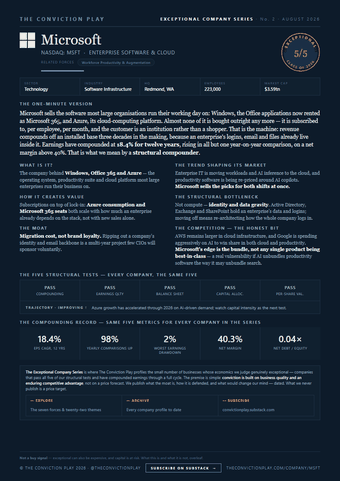
Microsoft sells the software most large organisations run their working day on: Windows, the Office applications now rented as Microsoft 365, and Azure, its cloud-computing platform. Almost none of it is bought outright any more — it is subscribed to, per employee, per month, and the customer is an institution rather than a shopper. That is the machine: revenue compounds off an installed base three decades in the making, because an enterprise's logins, email and files already live inside it. Earnings have compounded at 18.4% for twelve years, rising in all but one year-on-year comparison, on a net margin above 40%. That is what we mean by a structural compounder.
The five structural tests
Trajectory: improving ↑ — Azure growth has accelerated through 2026 on AI-driven demand; watch capital intensity as the next test.
The compounding record
The same five measures for every company in the series, so any two can be read against each other.
Why the economics are exceptional
Subscriptions on top of lock-in. Azure consumption and Microsoft 365 seats both scale with how much an enterprise already depends on the stack, rather than with new-customer wins alone. Revenue compounds off an installed base three decades in the making.
The switching cost is identity and data gravity. Active Directory, Exchange and SharePoint hold a company's logins and its files. Migrating off is not a procurement decision but a multi-year re-architecture of how every employee signs in — a project few CIOs will sponsor voluntarily.
The bundle is the product. Microsoft rarely needs to be best-in-class in any single category; it needs to be good enough in all of them at a price that makes unbundling irrational.
The honest risk. That same bundle logic is the vulnerability. AWS remains larger in cloud infrastructure and Google is spending heavily on AI. If AI unbundles productivity software the way it may unbundle search, good-enough-everywhere stops being a defence.
Earnings, twelve years
Two down years in eleven, and both were made back inside twelve months. The shape is the grade. Source: Legend, from company filings and market data, as at 25 August 2026.
Exceptional Company Series
Microsoft — the two-page fact sheet
Everything on this page, laid out to be read in one sitting or printed: what the business is, the five structural tests, twelve years of earnings, and the honest risk list. No valuation and no price target — the same rule as the writing.
Download the PDF ↓Closing price, USD — not a valuation, not real-time. As of 2026-09-08.
Published 2026-06-20: Down close to a third from its high. The article asks what the enterprise trust layer is actually worth.
- Sector
- Technology
- Industry
- Software - Infrastructure
- Related forces
- Software-Led Process AutomationAutomation and machine-performed workAlgorithmic Decision InfrastructureAutomation and machine-performed work
- Head office
- United States

- Employees
- 223,000
- Market cap (as of 2026-09-08)
- USD 3,710,545,297,408
- Return on equity (as of 2026-09-08)
- +34.0%
- P/E (trailing)
- 27.9×
- Profit margin
- 40.3%
- Dividend yield
- 0.73%
- Beta (5y monthly, vs S&P 500)
- 1.11
- 52-week range
- 349.20 – 553.72 USD
- Website
- microsoft.com
- Growth (YoY, company-reported)
- Revenue +17.7% · EPS +26.7%
Where this sits
Every company here is put through the same five structural tests. A small number clear all five and stay clear — those are the Exceptional Company Series. The rest are on the same map, each saying in its own words what it passed and what it did not.
New pieces go out by email — and by ear
One company at a time, put through the same five structural tests. No trading alerts, no model portfolio, no urgency — in your inbox or your podcast feed.