Company profile · MA
Mastercard
Global payments network
Exceptional Company Series
Passes all five structural tests and clears our elevated bar on both the strength of the business today and the consistency of its earnings record. An assessment of business quality, not a buy signal — exceptional can also be expensive. Why → · About the series →
Listen instead
2:28 · 2.4 MB · narrated by a synthetic voice, not by the author
Read the transcript
This is The Conviction Play. Mastercard, global payments network.
Mastercard doesn't lend money and doesn't issue cards. It owns the rails that move money between the bank that issued your card and the bank that serves the merchant, and takes a small fee on nearly every transaction that crosses them.
A network is worth more the more merchants accept it and the more cardholders carry it. A new entrant needs both sides at once, and neither side commits first. That is why the card duopoly, Mastercard and Visa, has held for decades despite enormous incentive to break it.
Processing one more transaction costs the network almost nothing, so revenue growth converts to profit growth at a rate very few businesses can match. It needs almost no capital to grow: spending itself does the work.
The threat is not a rival card network. It is the card being bypassed entirely -- real-time bank-to-bank rails, government-backed payment schemes, and stablecoin settlement all route around the swipe rather than compete with it directly.
It passes all five structural tests, the same gate every exceptional member clears -- the closest candidate on our current bar. What is missing is consistency: the earnings record would need fewer down periods and a shallower worst drawdown to close the rest of the gap.
The full profile on Mastercard is on the site. Free, no email address, no paywall, at the conviction play dot com.
A note before we finish. This episode is narrated by a synthetic voice, not by the author. It is an assessment of business quality, not a view on the share price: nothing here is a valuation, a price target, or a recommendation to buy or sell anything. A company can sit outside one of our frameworks and still be a fine business and a fine investment, and we publish those too, with the reason, because an assessment that only speaks about its winners is marketing. The Conviction Play publishes general commentary for information only. It is not investment advice, and capital is at risk. This reflects what was known on the day it was recorded.
That was Mastercard, from The Conviction Play. Thank you for listening.
The one-minute version
Mastercard doesn't lend money or issue cards — it owns the rails that move money between banks, merchants and cardholders, and takes a small fee on nearly every transaction that crosses them. The business needs almost no capital to grow: process one more transaction and the marginal cost is close to zero, so revenue scales with global spending itself. Earnings have compounded at 16.9% for twelve years on a 46% net margin. That is what we mean by a structural compounder.
The five structural tests
Trajectory: stable → — EPS grew 18.9% over the latest reported year, against 17.4% the year before.
The compounding record
The same five measures for every company in the series, so any two can be read against each other.
Why the economics are exceptional
A toll on money in motion. Mastercard neither lends nor issues cards. It owns rails that move money between banks, merchants and cardholders, and takes a small fee on nearly every transaction that crosses them.
Marginal cost is close to zero. Processing one more transaction consumes almost nothing, so revenue growth converts to profit growth at a rate very few businesses of any kind can match.
The moat defends itself. A network is worth more the more merchants accept it and the more cardholders carry it. A new entrant needs both sides at once, and neither side will commit first — which is why the duopoly has held for decades despite enormous incentive to break it.
The honest risk. The threat is not a rival card network but the card itself being bypassed — real-time bank-to-bank rails, government-backed schemes, and stablecoin settlement all route around the swipe.
Earnings, twelve years
Weakest point: 2021, 19% off the prior peak. Source: Legend, from company filings and market data, as at 31 August 2026.
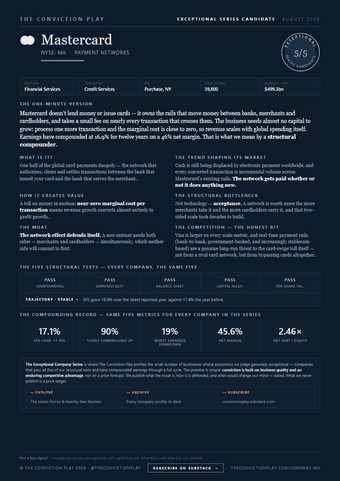
Exceptional Company Series
Mastercard — the two-page fact sheet
Everything on this page, laid out to be read in one sitting or printed: what the business is, the five structural tests, twelve years of earnings, and the honest risk list. No valuation and no price target — the same rule as the writing.
Download the PDF ↓Closing price, USD — not a valuation, not real-time. As of 2026-09-08.
Published 2026-08-31: The closest of our candidates to the exceptional bar. No article yet -- a candidate profile, not a series member.
- Sector
- Financial Services
- Industry
- Credit Services
- Head office
- United States

- Employees
- 39,800
- Market cap (as of 2026-09-08)
- USD 507,393,736,704
- Return on equity (as of 2026-09-08)
- +241.2%
- P/E (trailing)
- 31.8×
- Profit margin
- 46.3%
- Dividend yield
- 0.60%
- Beta (5y monthly, vs S&P 500)
- 0.73
- 52-week range
- 464.52 – 601.62 USD
- Website
- mastercard.com
- Growth (YoY, market data)
- Revenue +14.1% · EPS +22.1%
Where this sits
Every company here is put through the same five structural tests. A small number clear all five and stay clear — those are the Exceptional Company Series. The rest are on the same map, each saying in its own words what it passed and what it did not.
New pieces go out by email — and by ear
One company at a time, put through the same five structural tests. No trading alerts, no model portfolio, no urgency — in your inbox or your podcast feed.