Company profile · ANET
Arista Networks, Inc.
Datacentre switching, with a single operating system across the range
Exceptional Company Series · No. 7
Passes all five structural tests and clears our elevated bar on both the strength of the business today and the consistency of its earnings record. An assessment of business quality, not a buy signal — exceptional can also be expensive. Why → · About the series →
Listen instead
3:43 · 3.6 MB · narrated by a synthetic voice, not by the author
Read the transcript
This is The Conviction Play. Arista Networks, cloud networking. Number seven in our Exceptional Company Series, the businesses our framework grades exceptional.
Arista builds the switches that move data inside large datacentres, and runs one operating system across the entire product range rather than a different one per box. That is the whole argument: a network engineer learns it once, and the software is what is actually being bought. Earnings have compounded at 35.9% for twelve years with a worst fall of 8.3%, on margins, 45.4% at the operating line, that are unusual for a company that ships physical hardware.
High-speed switches for large datacentres, all running one operating system, EOS, across the entire range.
Why the economics are exceptional. One operating system, every box. Arista runs a single software image across its range, where the industry norm has been a different codebase per product family. The switching hardware is largely merchant silicon anyone can buy; what a customer is paying for is the software on top of it and the fact that it behaves the same everywhere.
The switching cost is the engineer. A network team that has built its automation and its habits around one operating system does not move for a cheaper box, because the box was never the expensive part.
Hardware margins that do not look like hardware. Operating margin of 45.4% and net margin of 38.4%, with no debt at all, is a software company's financial shape attached to a business that ships metal.
The honest risk, and it is the large one. Arista's revenue is concentrated in a small number of very large cloud customers, and the current demand for AI infrastructure is the engine underneath the recent growth. Concentrated customers can build their own, delay a build-out, or simply negotiate; that is the number to watch rather than the margin.
Three numbers to take away. Over 12 years, earnings per share compounded at 35.9% a year. 95% of the year-on-year comparisons were up. The worst fall in earnings was 8.3%.
The written profile of Arista Networks is on the site, and it goes further than this: the twelve-year earnings record as a chart, the figures behind every claim you have just heard, and the sources for all of them. It is free, with no email address and no paywall.
The Exceptional Company Series also covers Intuitive Surgical, Microsoft, Netflix and three more. Everything we publish is at the conviction play dot com, and the recordings are collected there under Listen.
A note before we finish. This episode is narrated by a synthetic voice, not by the author. Now the important part. This is an assessment of business quality, and it is not a buy signal. It is not a valuation, not a price target, and not a recommendation to buy or sell anything. Exceptional can also be expensive. A company in this series can pass every test we set and still lose you money for years, if you buy it at the wrong price. ResMed fell 51 per cent from its high, spent more than five years below that price and has still not regained it, and its earnings rose the whole way through. The Conviction Play publishes general commentary for information only. It is not investment advice and it is not a personal recommendation. Capital is at risk, and the value of investments can fall as well as rise. This assessment reflects what was known on the date of recording, and nothing in it updates itself.
That was Arista Networks, number seven in the Exceptional Company Series, from The Conviction Play. Thank you for listening.
The one-minute version
Arista builds the switches that move data inside large datacentres, and runs one operating system across the entire product range rather than a different one per box. That is the whole argument: a network engineer learns it once, and the software is what is actually being bought. Earnings have compounded at 35.9% for twelve years with a worst fall of 8.3%, on margins — 45.4% at the operating line — that are unusual for a company that ships physical hardware.
The five structural tests
Trajectory: improving ↑ — Revenue up 37.7% and EPS up 35.7%, against a 35.9% twelve-year CAGR — growth is running at the long-run rate rather than decaying towards it, which at this size is the unusual part.
The compounding record
The same five measures for every company in the series, so any two can be read against each other.
Why the economics are exceptional
One operating system, every box. Arista runs a single software image across its range, where the industry norm has been a different codebase per product family. The switching hardware is largely merchant silicon anyone can buy; what a customer is paying for is the software on top of it and the fact that it behaves the same everywhere.
The switching cost is the engineer. A network team that has built its automation and its habits around one operating system does not move for a cheaper box, because the box was never the expensive part.
Hardware margins that do not look like hardware. Operating margin of 45.4% and net margin of 38.4%, with no debt at all, is a software company's financial shape attached to a business that ships metal.
The honest risk, and it is the large one. Arista's revenue is concentrated in a small number of very large cloud customers, and the current demand for AI infrastructure is the engine underneath the recent growth. Concentrated customers can build their own, delay a build-out, or simply negotiate; that is the number to watch rather than the margin.
Earnings, twelve years
42 year-on-year comparisons in twelve years. Ninety-five per cent of them up, with a worst fall of 8.3 per cent. Source: Legend, from company filings and market data, as at 28 August 2026.
Exceptional Company Series
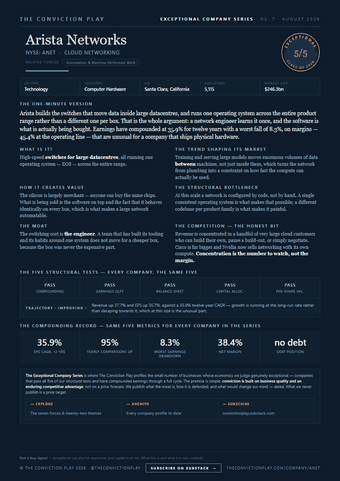
Arista Networks, Inc. — the two-page fact sheet
Everything on this page, laid out to be read in one sitting or printed: what the business is, the five structural tests, twelve years of earnings, and the honest risk list. No valuation and no price target — the same rule as the writing.
Download the PDF ↓Closing price, USD — not a valuation, not real-time. As of 2026-09-08.
Published 2026-08-28: Runs one operating system across every switch it makes, so the thing a customer is really buying is the software and the habits built on it.
- Sector
- Technology
- Industry
- Computer Hardware
- Head office
- United States

- Employees
- 5,115
- Market cap (as of 2026-09-08)
- USD 244,400,128,000
- Return on equity (as of 2026-09-08)
- +31.5%
- P/E (trailing)
- 61.3×
- Profit margin
- 38.4%
- Beta (5y monthly, vs S&P 500)
- 1.62
- 52-week range
- 114.52 – 214.89 USD
- Website
- arista.com
- Growth (YoY, market data)
- Revenue +37.7% · EPS +35.7%
Where this sits
Every company here is put through the same five structural tests. A small number clear all five and stay clear — those are the Exceptional Company Series. The rest are on the same map, each saying in its own words what it passed and what it did not.
New pieces go out by email — and by ear
One company at a time, put through the same five structural tests. No trading alerts, no model portfolio, no urgency — in your inbox or your podcast feed.